If you sell soap and your label is missing even one required element, you could face product seizure, FTC fines, or forced recalls even as a small home-based maker. This guide tells you exactly what your soap packaging label must include, which laws apply to your product, and how to future-proof your labels for the MoCRA 2026 changes already in motion.
Whether you make handmade soap, run an artisan soap brand, or manufacture at scale, the rules are clear once you know where to look. Let’s go through all of it.
What Laws Govern Soap Labeling Requirements in the USA?
Three federal laws and four agencies control soap labeling requirements in the United States. Which ones apply to you depends on how you classify and market your product.
The Fair Packaging and Labeling Act (FPLA)
Enforced by the Federal Trade Commission (FTC), this is the baseline law for all consumer products. If your soap is classified as “true soap,” the FPLA is your primary rulebook.
The FD&C Act (Federal Food, Drug, and Cosmetic Act)
Enforced by the FDA, this applies the moment your soap makes a cosmetic or drug claim like “moisturizes skin” or “kills bacteria.”
The Federal Hazardous Substances Act (FHSA)
Enforced by the Consumer Product Safety Commission (CPSC), this covers safety warnings for products that may pose a hazard under normal use.
The Modernization of Cosmetics Regulation Act of 2022 (MoCRA)
This is the biggest change to U.S. cosmetic law in decades. MoCRA added facility registration, product listing, fragrance allergen disclosure, and adverse event reporting requirements. As of early 2026, over 14,000 facilities have registered with the FDA under this law.
True Soap vs. Cosmetic: The Difference That Changes Your Label Completely
This single distinction controls everything about your soap labeling compliance. Get it wrong and you are either over-labeling unnecessarily or more dangerously under-labeling illegally.
True soap is defined by the FDA as a product whose cleaning action comes entirely from alkali salts of fatty acids the result of the saponification process using oils and lye. If you label and market it only as soap for cleansing the body, the CPSC regulates it under the FPLA. Ingredient lists are not required.
Cosmetic soap is any soap that makes claims beyond cleansing moisturizing, exfoliating, deodorizing, brightening, or making skin look better. These claims trigger FDA oversight under the FD&C Act and require a full INCI ingredient declaration.
Drug soap goes further. Claims like “kills 99.9% of germs,” “treats eczema,” or “reduces acne bacteria” reclassify your product as an unapproved new drug subject to far stricter pre-market requirements.
The rule is this: your marketing claims decide your regulatory category. The same bar of soap can fall under three different legal frameworks depending entirely on the words you put on the label.
The 4 Required Elements on Every Bar Soap Label (FPLA Minimum)
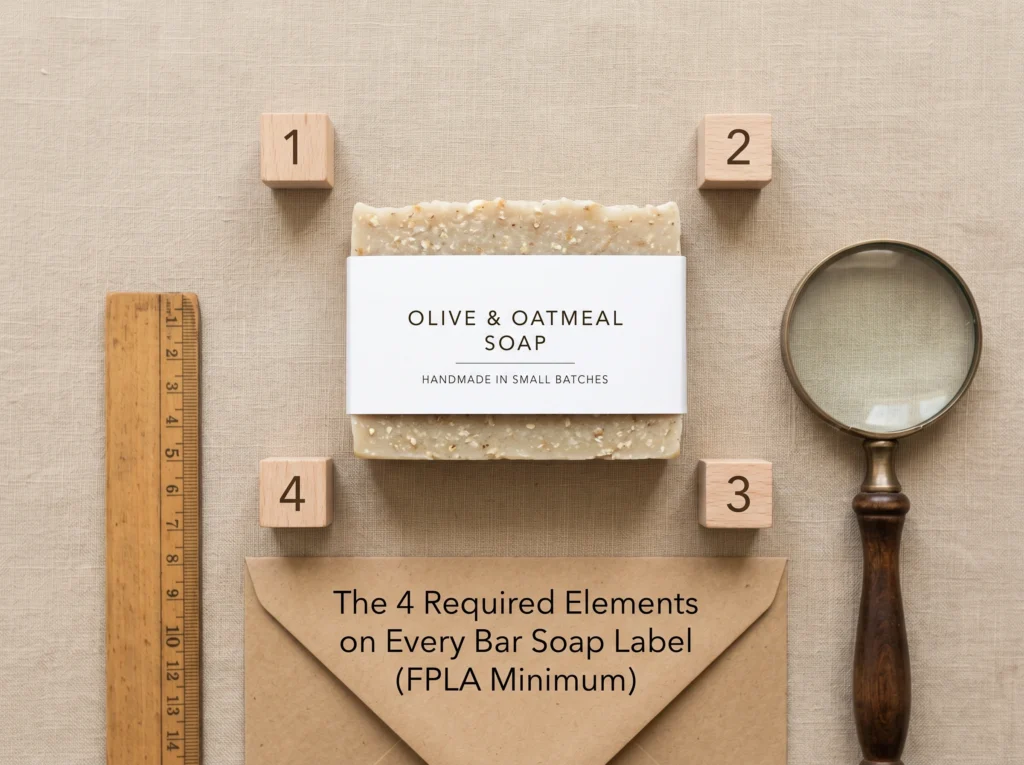
For true soap regulated under the FPLA, your bar soap label must include exactly four things. These go on every single bar you sell, no exceptions.
1. Product Identity
The label must state what the product is using its common or usual name. For soap, that word is “soap.” The product identity statement must appear on the principal display panel the front face of your packaging and must be large enough to read without effort.
A whimsical name alone, like “Morning Fields” or “Citrus Dream,” does not satisfy this requirement. The word “soap” (or “bar soap”) must also be present and prominent.
2. Net Contents (Net Weight)
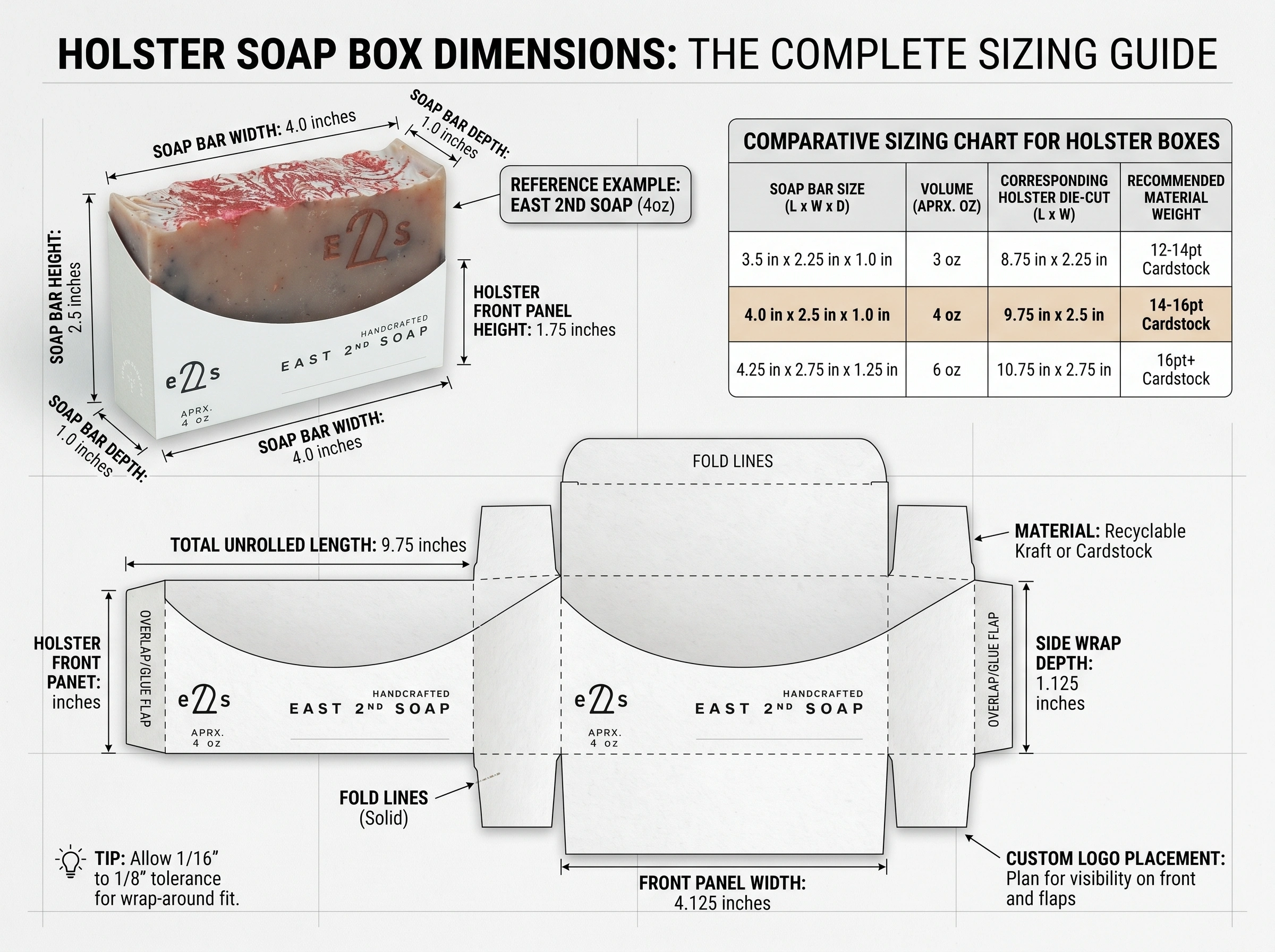
The net weight must appear on the front panel, in the bottom 30% of the label, running parallel to the base. It must be stated in both units:
For solid bar soap: ounces (oz) and grams (g), prefixed with “Net Wt.” or “Net Weight” For liquid soap: fluid ounces (fl oz) and milliliters (ml)
Example: Net Wt. 4 oz (113 g)
Critical note for bar soap makers: Bar soap loses water weight as it cures. If you weigh bars before curing and print labels, your stated weight will be higher than the actual weight at point of sale. Always weigh after curing. Overstating net weight violates the FPLA.
3. Manufacturer Name and Address
The full name and physical or mailing address of the company responsible for the product must appear on the label. This can be your personal name, your business name, or a registered DBA (doing business as) name whichever is your legal business identity in your state.
4. No False or Misleading Claims
While not a “label element” in the traditional sense, the FTC and FDA both prohibit any labeling that deceives or misleads the consumer. This includes ingredient claims, origin claims, organic claims, and benefit claims that cannot be substantiated.
Also Read: Different Printing Techniques for Soap Boxes: The Complete 2026 Guide
Cosmetic Soap Labeling: What the FDA Requires When You Make Claims
Once your soap crosses into cosmetic territory, your FDA requirements for handmade soap packaging expand significantly. Here is what you must add:
Full INCI Ingredient Declaration
Every ingredient must be listed using its proper INCI name (International Nomenclature of Cosmetic Ingredients) in descending order of concentration highest amount first. Ingredients present at less than 1% may be listed in any order at the end. FDA-approved color additives are listed last.
Common INCI name examples:
- Olive oil → Olea Europaea (Olive) Fruit Oil
- Coconut oil → Cocos Nucifera (Coconut) Oil
- Lavender essential oil → Lavandula Angustifolia (Lavender) Oil
- Lye (in finished soap) → Sodium Hydroxide (if listing inputs) or Sodium Olivate / Sodium Cocoate (if listing outputs)
Use the HSCG Ingredient Database to find the correct INCI names for all your ingredients.
- MoCRA Adverse Event Contact Information
Under MoCRA 2022, cosmetic labels must include a U.S. address, phone number, or electronic contact point so consumers can report adverse reactions. This is a newer MoCRA compliance requirement many small makers have not yet added to their labels.
- Fragrance Allergen Disclosure (2026 Rule)
The FDA is finalizing a rule under MoCRA that will require specific fragrance allergen disclosure on cosmetic labels. The proposed rule defines which allergens and at what concentration thresholds they must be listed. This rule is expected to take effect in 2026. If your soaps contain fragrance oils or essential oil blends, review your formulas now.
- Professional Use Labeling
If a product is intended solely for use by licensed professionals estheticians, cosmetologists, salon staff the label must clearly state it is for professional use only.
Soap Label Requirements
The fastest way to check your label before printing.
| Label Element | True Soap (US) | Cosmetic Soap (US/FDA) | EU Soap (All Types) |
|---|---|---|---|
| Product identity | Required | Required | Required |
| Net weight (oz + grams) | Required | Required | Required |
| Manufacturer name + address | Required | Required | Required (+ EU Responsible Person) |
| INCI ingredient list | Not required | Required | Always required |
| Fragrance allergen disclosure | Not required | Required (2026) | Required now |
| FDA-approved color additives | Not required | Required | Required |
| Batch / lot number | Not required | Recommended | Required |
| Best before / expiry date | Not required | Recommended | Required if shelf life under 30 months |
| Adverse event contact info | Not required | Required (MoCRA) | Required |
| “For external use only” warning | As needed | As needed | As needed |
| Professional use statement | As needed | As needed | As needed |
| USDA Organic seal | Only if NOP certified | Only if NOP certified | Separate EU organic rules apply |
Organic and Clean Beauty Claims: What You Can and Cannot Say
This is where many soap labeling mistakes happen and where the FTC pays close attention.
“Organic” claims are regulated by the USDA National Organic Program (USDA NOP). The rules:
You may display the USDA Organic seal only if your product is certified under the NOP. Without certification, you cannot make any organic claim on the principal display panel or use the seal anywhere on the package. You may identify individual certified organic ingredients as organic and state the percentage of organic content on the information panel.
- “Cruelty-free” this term is not legally defined by the FDA or FTC. It carries no enforceable standard. Brands that use it should be prepared to explain what they mean by it if challenged.
- “Hypoallergenic claim soap” also not regulated. The FDA has proposed rules on this term but has not finalized them. Use with clear internal documentation of what testing you have done.
- “Sulfate-free,” “paraben-free,” “fragrance-free” these are permissible negative claims if accurate. Make sure they are true for your formula. A product labeled “fragrance-free” must contain no added fragrance materials even masking fragrances.
- “Dermatologist tested” permissible if true and testable. Have documentation.
- “Vegan soap label” claims permissible if accurate. No federal certification exists; third-party certifications (like Vegan Action) add credibility.
- “Plant-based soap packaging” and “eco-friendly packaging claims” these fall under the FTC Green Guides. Claims must be specific, substantiated, and not overstated. “100% compostable” requires proof.
Font Size, Placement, and Design Rules for Soap Labels
Your soap label design must follow specific physical rules not just content rules.
- Minimum type size: All required text must be at least 1/16 of an inch tall. This applies to net weight, product identity, and warning statements.
- Net contents placement: Bottom 30% of the principal display panel, parallel to the base of the package.
- Principal display panel size: For rectangular packages, it is one full large side. For cylindrical containers like tubes, it is 40% of the total surface area facing the consumer.
- Clear space: Required label information must not be obscured by graphics, overlapping design elements, or color choices that reduce contrast and legibility.
- Warning statement placement: Warnings may appear on the back or sides of the package, but must be prominent and conspicuous not in a font smaller than 1/16 inch.
Practical design guidance:
Use no more than two fonts on the entire label. One for headlines, one for body text. More than two creates visual noise that reduces trust. State your net weight in grams and ounces in the bottom front panel not on the back. Keep the word “soap” large and visible on the front. It is both a legal requirement and a purchase signal. If selling in the EU, add the batch/lot number and best before date even if selling in the US, these are good practice for product recall readiness.
EU vs. US Soap Labeling: Key Differences
If you sell internationally or plan to, the gap between EU vs. US soap labeling regulations is significant.
In the EU, all soap including true soap is regulated as a cosmetic under EU Cosmetic Regulation (EC) No. 1223/2009. That means:
Full INCI ingredient declaration is always mandatory, even for plain bar soap. Ingredients are listed as what comes out of saponification Sodium Olivate, not olive oil and lye. A designated EU Responsible Person must be named on the label or in accompanying documentation. Batch/lot number is required on every unit. Expiry date or minimum durability (“best before”) is required for products with a shelf life under 30 months. Fragrance allergen disclosure is already law in the EU the threshold is 0.01% in rinse-off products and 0.001% in leave-on products.
In the US, true soap avoids most of these requirements. But as MoCRA continues to roll out, the gap between US and EU rules is narrowing particularly around fragrance allergens and facility registration.
Also Read: Top 9 Soap Packaging Companies in 2026
Trending Soap Label Strategies That Boost Sales
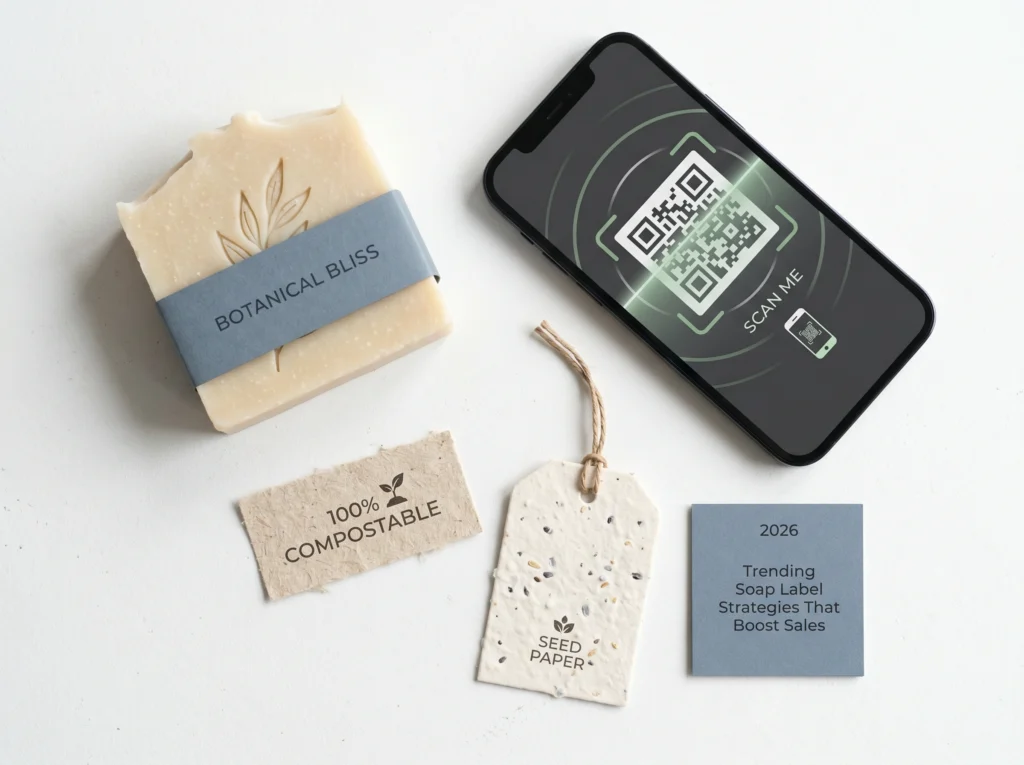
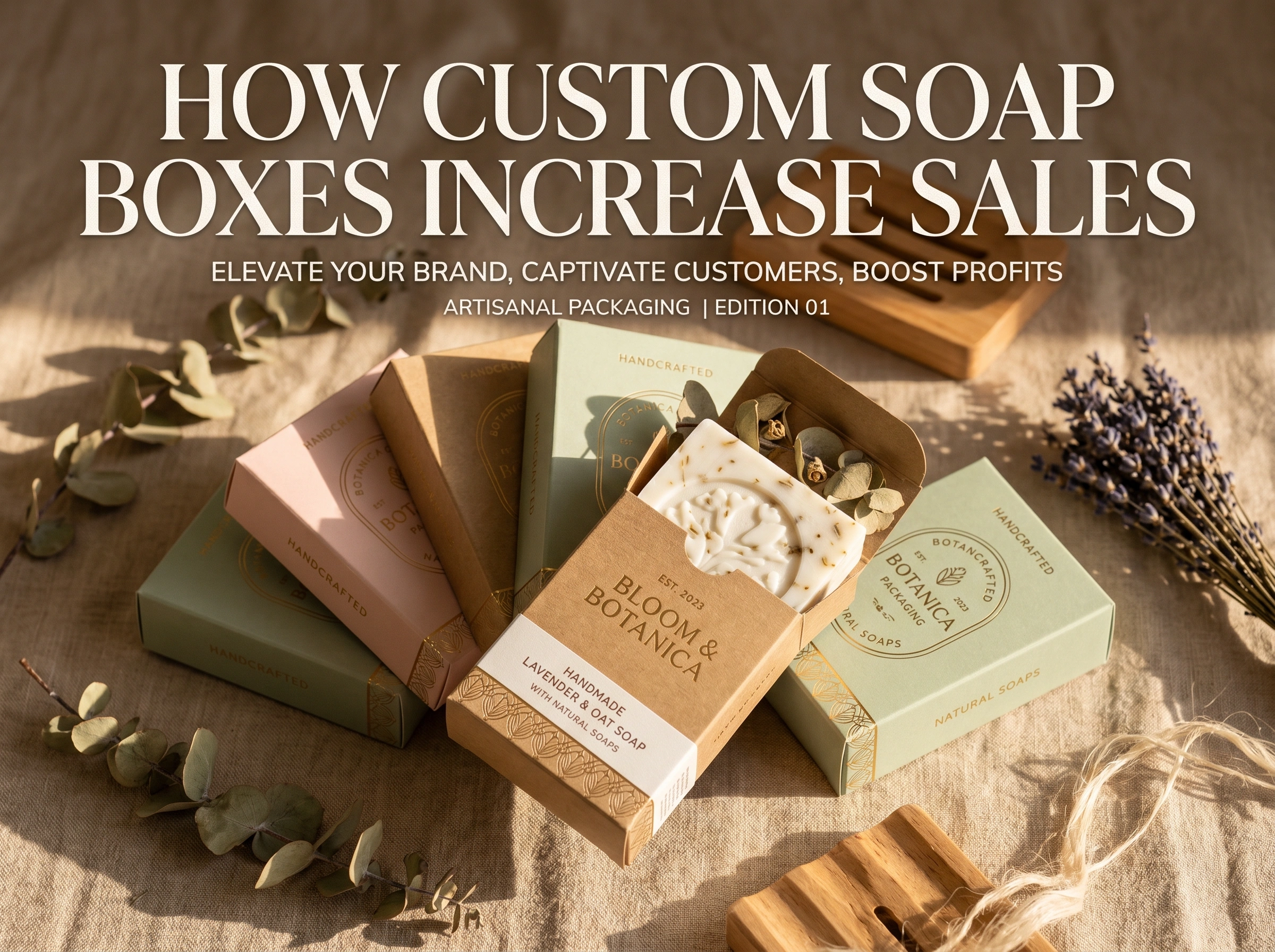
Beyond compliance, your soap packaging label is a sales tool. Here is what leading soap brands are doing right now to stand out on shelves and in search:
QR Code Soap Labels
A QR code on your label links customers to your full ingredient sourcing story, how-to-use videos, and certifications. This satisfies growing consumer demand for transparent ingredient labels without cluttering a clean design. It also creates a trackable marketing touchpoint.
Minimalist Soap Packaging
The minimalist soap packaging trend continues to lead in 2026. Consumers associate visual restraint with ingredient purity. A label with clean typography, one or two colors, and white space signals confidence in the product itself.
Zero Waste and Biodegradable Labels
Compostable soap sleeve labels, seed paper wraps, and biodegradable soap labels are increasingly expected by eco-conscious buyers. The FTC Green Guides require that “compostable” claims be accurate and qualified so work with your label printer to confirm certifications before printing.
Refillable and Waterless Soap Packaging
Waterless soap packaging concentrated bars, powder formats, and dissolvable sheets is a fast-growing category. These products require clear directions for use on the label since the usage format is not self-evident to most consumers.
Solid Shampoo Bar Label Requirements
This is one of the most searched topics in the soap and beauty space right now. Solid shampoo bars are cosmetics not true soap and must carry full FDA-compliant INCI ingredient declarations. Many sellers still label them as soap and unknowingly break federal rules.
AI-Designed Soap Labels
More brands are using AI tools to generate label concepts. The compliance responsibility still falls on the seller AI tools do not know your regulatory category or your specific formula. Use AI for design inspiration; use regulations for content requirements.
How to List Soap Ingredients the Right Way
For cosmetic soap, there are two accepted methods for listing ingredients in the US. Both are legal. Choose the one that fits your production process.
Method 1 List what goes into the pot (input method)
You list raw ingredients including sodium hydroxide (lye). This is straightforward if you measure everything going in. The challenge: some consumers see “Sodium Hydroxide” and worry. In finished soap, lye is fully converted through saponification it is not present in the final bar. A small note explaining this can ease customer concerns.
Method 2 List what comes out of the pot (output method)
You list the saponified forms of your oils: Sodium Olivate, Sodium Cocoate, Sodium Shea Butterate, plus any unsaponified fractions and glycerin. This is what the EU requires and what many US brands prefer for consumer clarity. The challenge: to list these accurately in descending order, you need to know the exact amounts present which requires lab testing or detailed formulation software.
For EU soap labeling, Method 2 is mandatory. For US sellers, either is acceptable under the FPLA and FDA 21 CFR Parts 700–740 but you must be truthful and non-deceptive in whichever method you use.
FAQS
Do I have to list ingredients on a bar soap label?
For true soap regulated under the FPLA and CPSC, no an ingredient declaration is not legally required. However, if your soap makes any cosmetic claim (moisturizing, exfoliating, deodorizing), FDA rules apply and a full INCI ingredient list is required. Many sellers list ingredients voluntarily for consumer trust.
What is the minimum font size on a soap label?
Required label information must be printed in a font no smaller than 1/16 of an inch in height. This includes net weight, product identity, and any warning statements.
Can I call my soap “organic” without certification?
No. The USDA Organic seal and the word “organic” on the principal display panel require USDA NOP certification. Without it, you may only note that specific ingredients are certified organic in the ingredient list.
What does MoCRA mean for small soap makers?
MoCRA 2022 requires cosmetic-classified product sellers to register their manufacturing facilities with the FDA every two years and submit product listings. Small businesses that only manufacture products for personal use are exempt. Sellers of cosmetic soaps even small batch makers are not automatically exempt and should review the MoCRA small business provisions carefully.
What is the difference between true soap and cosmetic soap for labeling?
True soap (alkali salts of fatty acids, marketed only as soap) follows CPSC/FPLA rules no ingredient list required. Cosmetic soap (makes claims beyond cleansing) follows FDA rules full INCI ingredient declaration, adverse event contact, and upcoming fragrance allergen disclosure required.
Do I need a warning label on bar soap?
Not always. Standard bar soap for body cleansing typically does not require warnings. Warnings are needed when there is a genuine safety concern for example, if the product could make a shower surface slippery, contains ingredients that may cause skin sensitivity, or is not safe for certain uses or users.
Final Word: Your Soap Label Is Your Brand’s First Promise
The best soap packaging label does two things at once: it meets every legal requirement and it earns the trust of the person holding it. Those two goals are not in conflict they reinforce each other.
A label that states the right product identity, displays the net weight in grams and ounces, includes your manufacturer name and address, and honestly represents your ingredients tells your customer: this maker knows what they are doing, and they stand behind what they make.
As MoCRA 2026 rules continue to take effect particularly around fragrance allergen disclosure and FDA facility registration staying current with your cosmetic label compliance is not optional. The brands that build compliance into their process from day one will not scramble when new rules go live.
Get your label right before you print. Then sell with confidence.